
HSSE remains the oil and gas sector’s number one priority. Integrated health, safety, security and environment management across the supply chain is essential to ensuring that employees return home safely to their families, and that any impact on the environment and industry assets is eliminated or minimised.
Industry efforts extend beyond the fenceline. Learning from local and international best practice, learning from incidents, focusing on long-term behavioural change, complying with legislation, empowering employees and contractors within the sector, and establishing a sustainable HSSE culture are key priorities for the Association’s members. The Fuels Industry continues to work with relevant stakeholders to achieve these objectives.
The industry landscape is currently undergoing significant transition. The South African operating environment continues to face economic, political, social and other challenges that have a direct bearing on safe and sustainable operations. In addition, the transition to low-carbon fuels, renewables and climate-related considerations is introducing new risks that need to be anticipated and managed.
Human factors continue to play a critical role in enhancing safety and in reducing and managing errors. The changing landscape will also require organisations to adapt, introduce new technologies and enhance skills to meet emerging challenges.
Priority areas
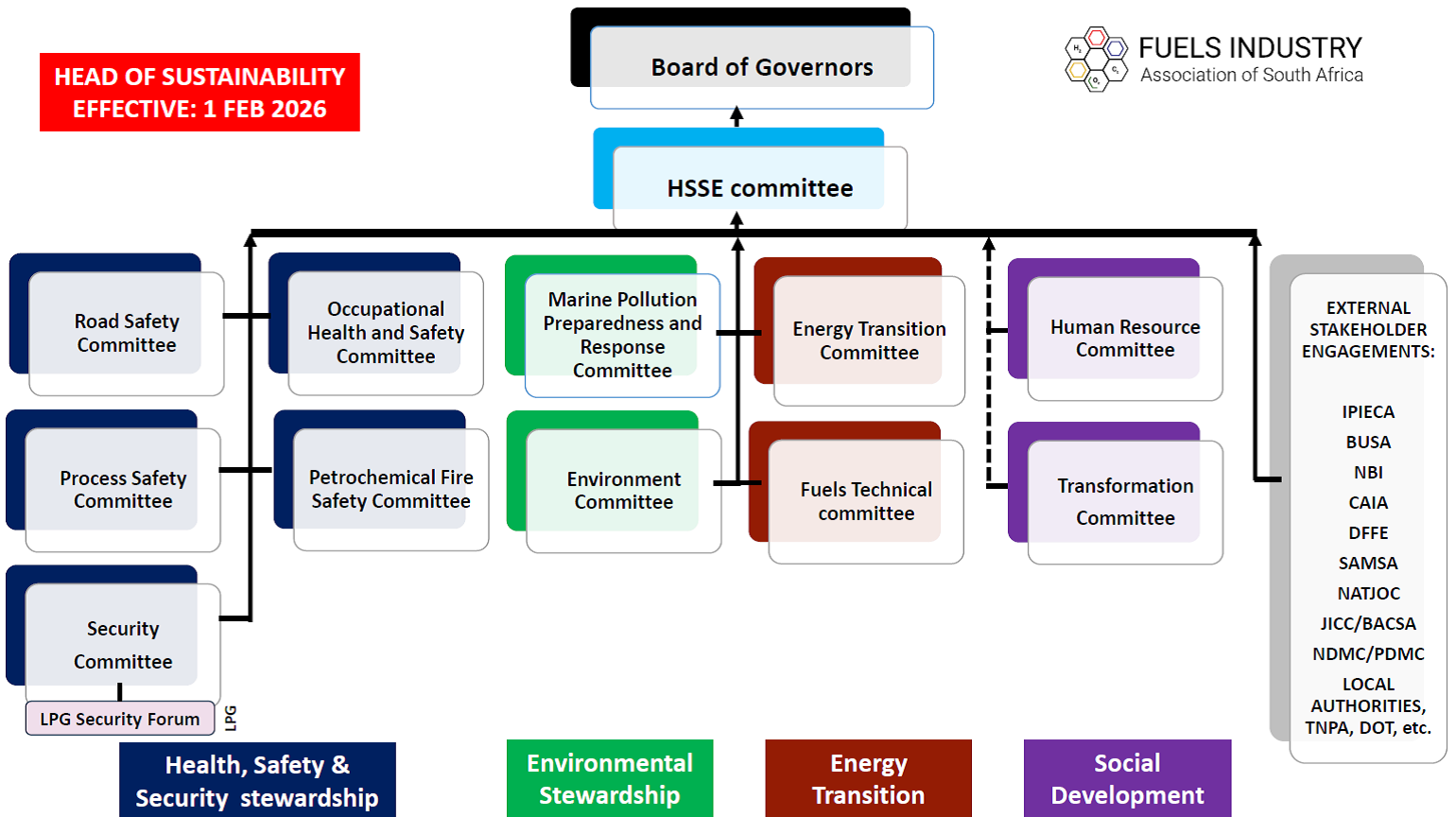
The Association continues to review its priorities. Risk-based decisions are taken at committee level and are endorsed by the Strategic HSSE Committee and the Board of Governors to address existing and potential risks within the following focus areas:
- Reducing HSSE risks in industry operations that impact people, the environment, assets and reputation.
- Reducing road transport risks and engaging stakeholders on third party risk management.
- Developing security related industry best practice to proactively assess threats and reduce security risks.
- Making recommendations to improve national oil spill response capability.
- Increasing contractor capability through collaborative industry efforts
Co-Ordinated Effort to Improve Security in the Oil Industry Sector
The DMRE derives its mandate from the White Paper on the Energy Policy of December 1998. The White Paper on Renewable Energy of November 2003 supplements the White Paper on Energy Policy. The Energy Security Master Plan for Liquid Fuels, which was approved by Cabinet in 2007, primarily addresses the short to medium term infrastructural constraints within the sector. A detailed list of the Acts, regulations, working rules, draft regulations, policies and strategy documents can be found here on the Department of Mineral Resources and Energy website.
The oil industry remains unshielded by the local and global socio-economic challenges. Fuel remains a high value commodity. The industry’s security challenges include fuel theft, vehicle hijackings, ATM bombings, armed robberies, piracy, potential terrorist threats, organised syndicates involved in bulk theft, strikes and social unrest among others.
The Fuels Industry Association of South Africa’s focus has been two-fold. An internal focus which includes joint security risk assessments to proactively address potential risks and threats as well as the use of leading security technologies to address some of our security challenges. The external focus is working with industry bodies, government and other stakeholders towards holistically addressing key security challenges such as hijacking and organised crime to name a few.
The Fuels Industry Association of South Africa has taken many steps to prevent crime, such as establishing the health, safety, security and environment committee, security sub-committee and refinery managers’ safety committee whose main focus is to address security issues and manage crime fighting projects. The industry has also united with government, the business sector, and representative associations to fight crime and make South Africa a safer country. The Fuels Industry Association of South Africa maintains an active, industry-wide security and crime prevention programme aimed at maximising the security and well-being of customers, employees, service station forecourts and assets.
The petroleum industry has implemented a number of initiatives to further minimise crime, such as improved cash-handling procedures by retailers and enhanced service station design which includes the addition of bullet-proof glass, panic buttons and closed circuit television systems at forecourts. Service station staff members are being empowered through specialised training programmes in the areas of robbery prevention and survival techniques. Staff members also receive regular information about crime pertinent to their operations in the form of newsletters and alerts. In addition, close liaison is being maintained with the South African Police Service (SAPS) to ensure a full investigation into every crime and to incorporate the findings into enhanced security measures.
Development of an Effective Oil Spill Response Strategy
The Department of Environmental Affairs (DEA), the SA Maritime Safety Authority (SAMSA) and the Fuels Industry Association of South Africa established the Oil Spill Response Advisory Forum (OSRAF) in 2014 to address shortcomings in the National Oil Spill Response Strategy as there were concerns that the existing institutional infrastructure and resources were inadequate to deal with a major oil spill incident at sea. The OSRAF has identified the most pressing issues that need to be addressed in order to achieve an effective strategy.
Road safety awareness campaign involving bulk delivery vehicles
In 2015, the Fuels Industry Association of South Africa embarked on this campaign to:
- Address the high number of road incidents in South Africa.
- Build awareness and educate pedestrians and motorists on the positive and negative impact of behaviour related to pedestrian safety.
- Build awareness and educate pedestrians and motorists on the negative impact of behaviour relating to impaired driving.
- Shift behaviours by focusing on individual responsibilities.
- Establish stakeholder relations to promote and support road safety.
